Showing posts with label hybrid. Show all posts

Wednesday, August 24, 2011

NEW Hybrid


Not HSD, no Voltec a thrid one ?

My idea

Mode EV : C1 : dis engaged, C2,C3 any state
Mode EV with more torque requirement : C1, C2 engaged, C3 disengaged

Extended Mode : Serial Mode : C3 Engaged, C1, C2 Disengaged
Extended Mode : Up hill more torque : C1,C2,C3 engaged


Regeneration : same EV mode
Home power Generator mode : c2 disengaged , C3 engaged


So for C1, C2,C3 can use Magnetic Clutch : . In simple words this contains 2 plates and the gap is filled with magnetorheological fluid (MR fluid). There is fluid storage and electro maganets. so when the clutch needs engaged, the fluid fills the gas and electric field is applied so the fluid truns to solid. At time of disengagement, remove the magnetic field and store the fluid back to container.


© yankandpaste®

Saturday, February 13, 2010

hybrid concept ?? -cont ... fixed gears ( was 14 mode hybrid )

Decided the change the title of the from 14 mode hybrid ?? to hybrid concept as now we are going beyond the a 14 mode concept.

Today i was thinking on it a bit more and introduction of a fixed gears to hybrid system.

Use case ? Lets say we want to increase the tow capacity on a particular profile. The same Electric motor + ICE works but if the truck is going a steep - as per the previous theory , the entire load will shift to electric motors as speed decreases. So by introducing a fixed gear system, the load requirement gets supported by ICE and Electric motors which helps to add more weight capability.

So this can work across all profiles. The control system/software needs to decide which one is more efficient on below
1) to use another cylinder
2) a fixed gear.


So finally we are getting more clear to have a hybrid system concept where we use only required optimal energy for a particular use which helps to increase the overall efficiency.

© yankandpaste®

Thursday, February 11, 2010

14 mode hybrid ?? -cont ... profiles

One of the major concern for a hybrid buyer is fuel economy. I found a nice way to tackle it in our hybrid concept by introducing profiles.

example:
  • Commuter Profile
  • Auto profile

The commuter profile makes the 5 cylinder engine to operate only 3 (or even 2 ) of its cylinders and use electric motors to support at extra power needs (similar to HSD/ BAS+ hybrid of GM ) which uses electric motor for low speeds, ICE at optimal rpm - gen, ICE at optimal rpm and ICE + electric motor for acceleration /up hills and regeneration at breaking.

The other idea is to support this profile with an aerodynamic canopy ( factory designed with canopy to have max aero effect on the optimal rpm /speed ) for better fuel efficiency.

So this takes off the worry daily commuter to have the truck or if truck is running long one side without any load and use the power only when its needed than running all cylinders all time. ( example a 3.7 ltr 5 cylinder engine, operating with 3 cylinder mode will have almost 2.22 ltr + electric motor power available - so it should offer better power and fuel economy than a 2.4 ltr 4 cylinder engined equinox ) . This should be good power for even 4 people drive + some loads ( remember equinox 2.4 ltr has a tow capacity of 1500 pounds.)

The Auto profile is to choose the ICE and electric motor combinations only according to the pre-programmed logic.

Its better to have more profiles to optimize the use resources more effectively ( like a medium mode ( 4 people / light load ) , tow mode ( fully loaded / tow ) etc.
1500

The base idea is like electric grid communication , use only optimal resources for any situation and save the rest. Organize the profiles in such a way to get maximum efficiency and allow to force to stick to some settings if needed.


© yankandpaste®

Tuesday, February 9, 2010

14 mode hybrid ??


Again thoughts on the above rendering

What engine option may be the best

I would love to have 3.7 ltr 5 cylinder direct injection rwd/4x4 hybrid - Only one ?? Yep Only one

When i say hybrid if you ask, - i don't know but i know it should have below modes

1) Electric only
2) 3 Cylinder
3) 3 Cylinder + electric motor
4 3 Cylinder + Generator
5) 3 Cylinder + electric motor + Generator
6) 4 Cylinder
7) 4 Cylinder + electric motor
8) 4 Cylinder + Generator
9) 4 Cylinder + electric motor + Generator
10) 5 Cylinder
11) 5 Cylinder + electric motor
12) 5 Cylinder + Generator
13) 5 Cylinder + electric motor + Generator
14) Regenerative mode ( on all times above modes and breaking etc )

so is it a 14 mode hybrid ?? ( 1+ 4 = 5 and 5 cylinder, so numerology matches ). May its better to put something like an 3 or a 5 (for numerology sake) letter acronym which can be pronounced easier.

One question may be why 5 cylinder : look at http://en.wikipedia.org/wiki/Straight-five_engine for more details.


In practical tests may be "'x' Cylinder + electric motor + Generator" mode need to be reconsidered based on the efficiency it can achieve. But its all depends on the control logic which is programmed by a firmware to activate and use the mode. On a transmission design point, all the modes should be possible without further hardware change.

The ICE should be optimized for peak efficiency and fixed rpm range and rest all should be handled with the Electric motor/Generator . The transmission need to designed so that it can have a trans output as a function of ice rpm, Electric motor and Generator. The existing technologies which is used in the 2 mode system (like active fuel management ,variable valve timing,direct injection etc) should make this.


One update is to make more modes with introduction of turbo charging . The modes will be increased to around 23 modes (2 + 3 = 5 again another numerology works) - which should be able to reduce the 3.7 ltr engine to a 2.5 ltr engine ( still 5 cylinder )

If this can be done, i am sure the design can achieve a very high fuel economy without sacrificing any power and will be good in emissions as it runs in optimal way all the time/modes.


How GM can do it ? Optimizing the 2 mode system and use the existing 3.7 ltr engine which goes in H3/Colorado. What is takes its only some time ,experiment spirit and test. Its all existing resources and only what it takes is incremental update of system.


© yankandpaste®

Friday, January 1, 2010

More inspirations on the way

Found a couple more inspirations


1984 Chevrolet Citation IV


Ford probe IV and V


GM Precept


Seems it now time for govt to act. They have to follow/make similar model of japan on defining a class of cars where which gets insurance and tax breaks ( like kei cars ) so that companies can come forward, make business cases and design and sell new products !!

Its not because companies has ideas to innovate but its only because govt is not allowing them to go out of the box solutions and gives opportunity to sell them them.


My ideas on the new class definition is like for a start they should come up with parameters like

Min: 80 mpg ( from regeneration and optimizations - no external alternative energy supply )
4 wheeler ( 2 - 4 seats )
should pass min crash test ratings ( ex: 3 stars for frontal, side, rollover etc )
etc etc.

For plug-in rules should be different and the standards should be moving , like 120mpg on 2015 .. and must plugin-features and safety features.

this makes more people buy commuter cars which are very effective and takes less to maintain + develops new ways to find solutions for problems apart from electrification and allows use of other technologies like aerodynamics,regenerations etc to be in practice.

For GM Precept its nice to have visit on : http://www.electrifyingtimes.com/gmprecept.html
© yankandpaste®

Saturday, December 26, 2009

My- Aero car thoughts and insperations

Seems i am using my time on vacation to draw pics :-) and getting the level of my kid. He seems to be drawing better too.

Today i was able to get a clear picture of an aero design from existing size requirements from a normal car.

Picture follows :-)


Even its easy to swap the engine space and boot space so that a RR (Rear-engine, rear-wheel drive) layout can be made from the above design. On other thoughts , Putting a hybrid power train may increase the fuel economy and EV ranges.

The basic idea is the reduce the frontal area - for CdA (mostly airfoiled frontal area and reduced the back area ) and increase/optimize the curves over top,down and sides to that they can contribute forward pull using aerodynamics. The top,sides and bottom curves seems much important as they can give resulting forward moving forces. The bottom (down part ) curve may help more to push to front and same time balance the extra down (vertical component ) of the force made by the top curve. Its also very important to optimize curves for max advantage of those parts without affecting the passenger comfort and utility space.

I took the base height, width and other ratios from a Volvo S70 (my current car which i like the space inside ) for the above model so that it can seat 5 comfortably and have enough space ( its not a small car now - its a 5 seat modern hatchback bigger than Toyota Prius).


To my wonder, Its really great to see some old models , Let me upload them also to get a pic of how people were thinking in old days.


1937 Pillsbug : CD of 0.13 6 -7 Passenger


1937 Maybach


Don't know the model info but looks EV1 was taken from this one.


1984 Chevrolet Citation IV concept


GM EV1


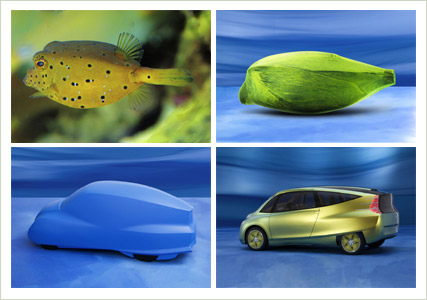
Mercedes-Benz bionic car

Links :

Ecomodder : 65+ tips : http://ecomodder.com/forum/fuel-economy-mpg-modifications.php


Cars to Emulate and Study: http://neilblanchard.vox.com/library/post/cars-to-emulate-and-study.html

© yankandpaste®

Sunday, December 20, 2009

An HHR replacer ?

A bit paint, base picture of an ev innovations Wave and here we go

A Ute and a 5 passenger hybrid crossover ? .


My wife was saying the first name came to mind after seeing the pics is "AirBus" .Second name she told was "Rino".

Intial comments came : Proportions are not proper, The CUV looks like more a stretched limo. the UTE looks good other need proportions adjustments :-)


Wondering this suites well to replace the HHR than an Orlando :-)

© yankandpaste®

Thursday, December 17, 2009

Hybrid Auto rickshaw

Was wondering what may really help the world. One idea found was a Hybrid Auto rickshaw.

Auto rickshaw is a very popular common man travel in India. I think its popular in all developing world where there is more man power available.

http://en.wikipedia.org/wiki/Auto_rickshaw

Looks its a very good use case for a Hybrid power train as

1) it has a lot of possibility for regenerative breaking as its runs more in city traffic and low speeds

2) An electric motor for low speeds can make the efficiency improvement

3) Most important : less pollution

4) Millage increase as ICE works more on optimized conditions

I am not sure why companies like bajaj is not considering a hybrid powertrain for an auto rickshaw


© yankandpaste®

Friday, May 22, 2009

Method and procedure for designing a Range extender EV from emission cycle standards

As new Cafe standards and and emission control standards are in place we need to improve the efficiency of the existing vehicles.

There are multiple approaches to address the issue:

  •  Improving existing ICE by use of new technologies and designs 
  •  Use of a supplement and increase the efficiency ( hybrids )
  •  Renewable non fossil energy ( EVs, fuel cells etc )

One of the problem people face on no fossil energy use  is the energy storage technologies are not affordable and the infrastructure is not ready and they are not proved. So we need an approach which is hybrid but more upgradable to future. As the Fuel cell and EVs depends on the electricity the approach needed to be electricity centric. 

One approach is a serial hybrid. There are other approaches like parallel hybrids, mild hybrids, strong hybrids, BAS hybrids etc. The good part of  serial hybrid is that its more future oriented and its a step closer to the renewable non fossil vehicles.

This post is an extension of the previous post of "something before volt".  This post is reflections of my thoughts on a 10 mile capable battery EREV. Because its for a 10 mile range, we assume the battery costs are less. We even  think it can be a ultra capacitor also because we need a device which can store and provide energy for the vehicle to travel 10 miles electrically.


The first step is a test EV ( electric vehicle ) which as capability to record the power used by the electric engine on a defined cycle. A cycle is a defined patten of driving for a particular time period. 

The Test  Ev will have the exact motor configuration we plan to have in our final product.
Example One motor 2 rear wheels ( say 90kw) and 2 in wheel motors ( 30kw ) for the 2 front wheels.

This configuration gives the advantages of rear wheel drive and on required conditions the front wheels can act and get AWD advantages. Secondly the front motors will  be more concentrating on regeneration of power from the regenerative breaking.


As a detailed step we will go through the different cycles defined by different standard authorities for the emission tests.

look at http://www.dieselnet.com/standards/cycles/ and get the required information , contact the  authorities and get the documents.

Some interesting cycles for US  are 

  1.  US06  : 600 seconds long  representation of aggressive, high speed and/or high acceleration driving behavior, rapid speed fluctuations, and driving behavior following start up.  http://www.dieselnet.com/standards/cycles/ftp_us06.html
  2.  FTP 75 : http://www.dieselnet.com/standards/cycles/ftp75.html
  3. HWFET cycle : http://www.dieselnet.com/standards/cycles/hwfet.html
  4. New york city cycle : http://www.dieselnet.com/standards/cycles/nycc.html
  5.  California Unified Cycle (UC) : http://www.dieselnet.com/standards/cycles/uc.html
  6. The SC03 Supplemental Federal Test Procedure : http://www.dieselnet.com/standards/cycles/ftp_sc03.html

etc etc. for a primary study on different cycles use : http://www.dieselnet.com/standards/cycles/

Similarly use all the countries you are interested in and get the cycle information. 

Now perform these cycles with the test EV and get all data points and plot graph on the power requirements against time , Now you have two graphs where one with speed vs time and second energy requirements vs time. 

Repeat the procedure with the cycles you have interest and make the data ready.

Now its time to choose a optimal electric generator with 
1) Emission characteristics matching the cycle requirement.
        2) Electricity generation capability which is at an optimal level for the above data collected cycles. Assume battery will be supplementing the extra power needs.

The modes the range extender will operate are :


  • PURE EV mode
  • Generator power only mode
  • Generator power + Battery power mode
  • Battery recharge mode
  • Generator power only run   and Battery recharge mode

Regeneration can occur on all the above mode as user uses the breaks and other regenerative mechanisms ( example: regenerative shock absorbers )


So as per the logic : The range extender will run on EV mode when the battery is full and above threshold range extender point. Lets say if its  10 mile battery 5 miles in EV mode
Once it reaches 5 miles, the generator kicks in and acts as primary source of running, Now the battery will act as a supplemental energy provider on acceleration, load and uphill ( more 
energy need scenarios ). The battery will be charged back when ever there is an opportunity for regeneration of the power. The generator will recharge the battery when the vehicle is 
in a stop position or need less power than the optimal point power which generator is deigned to generate.Once the power inside the battery reaches back to a level say "return EV mode point"
say 7 mile capability, the generator will be shut off back and the Range extender will run in a Pure EV mode. again when it hits back the threshold range extender point the generator will be kicking in again back.


The points 
 1) the constant generator capacity,
 2) Threshold range extender point
 3) Return EV mode point 

etc should be designed by the applications processing unit intelligence. This can be visualized as profiles ( example: city profile, High way profile, Up hill profile, AWD profile ,Intelligent AWD profile , etc will have different values for the points and will result in different drive experiences for the users). By adding plug in charging , the vehicle should be able to work as a plug in hybrid.


Once, the design of profiles are also completed, we will be almost ready will the design and only new places to explore may be the traction control mechanisms only. Once completing the data points and logic of control, we will be ready to develop the software needed and make out EREVs first tests. The data points can be perfected using software using proving grounds, test fleets 
etc and they can be always updated with software/firmware downloads.

Yes guys, We now did a design of a global focused designed EREV. Back to key points :

1) The Generator characteristics and control interface
2) The operating points
3) The traction control mechanisms to get max out of the electric motors
4) Electric motor characteristics
5) Power dissipation capabilities and storage capabilities of battery.


I think global vehicles can be born from more thinking than just dump executions.

   
© yankandpaste®

Saturday, May 9, 2009

Compressed air engines


Wondering this technology can be used as range extenders in EVs or PHEV or RE - EVs. One of the good points i see is no pollution at all. 

If these air engines offer constant RPM  and get the required power to generate the electricity then this will be one of the ground breaking technologies.  

The good part seems of PHEV/REEVs are:
1)  They can be charged over night for daily needs.
2)  For range anxiety needs the air compressed engines can be used.
3) On high speeds/Winds  using aerodynamic designs  the compressor can be re-filled.
4)  With small air compressor/ Old gas stations , we can refill the air with in minutes.


Some of the engine designs looks very good (i like the Engineair one ).


© yankandpaste®

Wednesday, May 6, 2009

Volt ? something before it ?

One of the problems we hear on GM Volt is its expensive, The component which makes it expensive is the battery.Is there a second way out ?


Again i started thinking and found a solution. Lets think of a below configuration

                  +--------------------------  Control  circuit
                  |                                                       |
Electric generator ------ Ultra capacitor----Electric Motor 

Why this is cost effective ?Genarator powers the electric motor,  The ultra capacitor stores the energy from the generator  some times ( like down hill, stops etc ) and other times it stores the regenerative energy . The electric motor takes electric energy from the ultra capacitor when it needs execss energy like up hill etc. This will be very cost effective as Ultra capacitr is not expensive as battery and range requiremnt is only 10 - 15 mile ( or even 5 mile )

If the Ultra capacitor can store energy for X miles AER, the Electric generator can always run in optimum capacity and be shut off till  the ultra capacitor reaches to be in a depletion area (say x-n ). Once its in depeltion area . the generator can charge and store more energy in it and support the power needs of the car by supplying additionl energy for uphill, merge etc. 


The down side : It wont perform on uphills like normal drive it the hill is very big/steep (after ultacapacitir runs out of energy ). 

 But comparing to the cost it should be a good step to consider before the volt and it will have less weight compared to BEVs and gives the cost effective first step on full electric drive. With the other idea listed ( the NP stroke engine and Active stroke mgmt ) this will be a 150 mpg cost effective vehicles.

This may be great config for a small car. intellectual property rights reserved for idea and implementation.


© yankandpaste®

Sunday, May 3, 2009

Accelerator pedal for electric Car


DC Motor scenario

A simple DC controller connected to the batteries and the DC motor. 

If the driver floors the accelerator pedal, the controller delivers the full 96 volts from the batteries to the motor. 
If the driver take his/her foot off the accelerator, the controller delivers zero volts to the motor. 
For any setting in between, the controller "chops" the 96 volts thousands of times per second to create an average voltage somewhere between 0 and 96 volts.


The controller takes power from the batteries and delivers it to the motor. The accelerator pedal hooks to a pair of potentiometers (variable resistors), and
 these potentiometers provide the signal that tells the controller how much power it is supposed to deliver. 

The controller can deliver zero power (when the car is stopped), full power (when the driver floors the accelerator pedal), or any power level in between.


AC motor scenario


In an AC controller, the job is a little more complicated, but it is the same idea. The controller creates three pseudo-sine waves. It does this by taking the DC voltage from the batteries and pulsing it on and off. In an AC controller, there is the additional need to reverse the polarity of the voltage 60 times a second. Therefore, you actually need six sets of transistors in an AC controller, while you need only one set in a DC controller. In the AC controller, for each phase you need one set of transistors to pulse the voltage and another set to reverse the polarity. 

You replicate that three times for the three phases -- six total sets of transistors.

Saturday, May 2, 2009

Regenerative breaking

Regenerative breaking is used on hybrid gas/electric automobiles to recoup some of the energy lost during stopping. This energy is saved in a storage battery and used later to power the motor whenever the car is in electric mode.

Understanding how regenerative braking works may require a brief look at the system it replaces. Conventional braking systems use friction to counteract the forward momentum of a moving car. As the brake pads rub against the wheels (or a disc connected to the axle), excessive heat energy is also created. This heat energy dissipates into the air, wasting up to 30% of the car's generated power. Over time, this cycle of friction and wasted heat energy reduces the car's fuel efficiency. More energy from the engine is required to replace the energy lost by braking.

Regenerative braking utilizes the fact that an electric motor can also act as a generator. The vehicle's electric traction motor is operated as a generator during braking and its output is supplied to an electrical load. It is the transfer of energy to the load which provides the braking effect.

As the driver applies the brakes through a conventional pedal, the electric motors reverse direction. The torque created by this reversal counteracts the forward momentum and eventually stops the car.

At the most basic level, regenerative braking means re-capturing the kinetic energy of the vehicle's motion and turning it into another type of energy. Commonly, this is done by converting kinetic energy into electricity and recharging the car's battery with it.The energy captured in the battery is used moving the car later and due to the energy capture and reutilization the mpg for the car improves drastically.


© yankandpaste®

What is cD and why does it matter?


Aerodynamics. When discussing overall efficiency, sometimes it's easy to overlook just how important the shape of an automobile is in determining how fuel efficient it is

First, let's discuss what the term aerodynamics means. According to Merriam-Webster, aerodynamics is "a branch of dynamics that deals with the motion of air and other gaseous fluids and with the forces acting on bodies in motion relative to such fluids." Clear as mud? In this case, the fluid we're talking about is indeed air, and the easier it is for an object to cut through the air, the less energy is required to keep that body in motion.


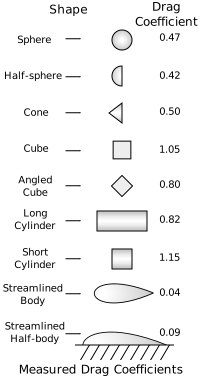
For the purpose of comparing different automotive designs, engineers measure the resistance of a body to flow through the air using computational fluid dynamics simulations and wind tunnel testing. A flat board held perpendicular to the air flow may have a coefficient of 1 or more, depending on the shape of the edges and the surface texture. The drag coefficient is a unitless number and is based on the shape and surface properties of the object. Two identical objects that are different sizes will have the same cD. However, that doesn't mean they have the same overall drag. 

This, of course, is further complicated by the vagaries of the real world. The addition of items like outside mirrors, windshield wipers and radio antennas can cause a lot of disruption to air-flow. There is also the fact that cars often don't travel perpendicular to air-flow. Vehicles often encounter cross-winds when driving down the road so the airflow must be measured at various angles to ensure resistance is kept to a minimum. 

Safety is also a concern.The air-flow over a vehicle's body can trigger either lift or down-force just as it does with an aircraft wing. If a vehicle's shape causes too much lift, it can make the vehicle unstable and difficult to control. All of these factors must be balanced in the final design.

The designers of all of the most fuel efficient vehicles ever offered for sale have taken aerodynamics very seriously and as such, they all have a very favorable cD. For instance, the GM EV1 scored a cD of 0.195, which is quite good. For comparison, the 2010 Toyota Prius manages a fine 0.25 and the Aptera 2e (above) blows them both out of the water air with an amazingly low 0.15. When multiplied by the car's frontal area, the Aptera design scores even better due to its narrow, bullet-like shape with narrow out-rigger front wheels that are completely shrouded . For what it's worth, the brick-shaped HUMMER H2 scores a dismal 0.57 – further proof that its designers were in no way concerned with its fuel efficiency.

Besides the actual bodywork of an automobile, there are other factors contributing to the overall coefficient of drag any given car is able to register, including the car's tires and its ride height. Wide tires move more air and therefore take more power to move, and the air pressure of a given tire can have drastic consequences on its ability to roll. 

Why is all of this so important? Calculations reveal that about 60 percent of the energy used to move the average car goes towards overcoming its aerodynamic drag. That's huge, and means that even small improvements in a car's cD can pay big dividends in overall fuel efficiency. 

Thursday, April 30, 2009

2 mode power train :Speed to time graph and modes.


2 mode powertrain, The  previous post shows mild hybrid and diagram . It gives a clear idea on differnce on mild hybrid and 2 mode hybrids (click on the pic to see it in detail )

The Two-Mode hybrid system maximizes city and highway fuel economy by integrating two electric continuously variable modes with four fixed mechanical gear ratios. The system consists of twin, active-cooled electric motors integrated into the automatic transmission. Energy to power the motors comes from a 300V nickel-metal hydride battery pack, which consists of nickel metal hydride modules and is packaged behind the second-row seat below the cargo floor.

In the first mode, at lower speed and lighter loads the 2-Mode Hybrid operates in one of three ways depending on conditions and battery charge level: all-electric power, internal combustion engine power or a combination of the two. All reverse operation is driven solely by the electric motors.

The second mode is used primarily to optimize fuel economy at highway speeds. It provides electric assist in addition to combustion engine power when conditions demand it, such as trailer towing and climbing steep grades, and to allow the engine to run at its most efficient point under less-demanding conditions.

No engine speed changes are necessary for the mode shift to occur. The result is exceptionally smooth, seamless acceleration and responsiveness. At all times, the Hybrid Optimizing System (HOS) collects torque-based data, deciphers it, then determines the most fuel-efficient means of propelling the 2-Mode Hybrid.


© yankandpaste®

Greenlings: What is a mild hybrid?

People like to categorize the world. It helps our brains figure stuff out, because we can only manage so much information. Lumping things into bins helps get information down to a manageable level. Unfortunately, most things don't readily fall into discrete categories. Hybrid drive technology is one of them, but we'll try anyway. On the continuum that is hybrid technology, we typically break things down into strong, mild and micro-hybrids. Strong hybrids include systems like Toyota's hybrid synergy drive, Ford's hybrid system and General Motors two-mode system. Micro-hybrids are really nothing more than automatic start stop systems.  Somewhere in between those groups lies the mild hybrid. The basic premise of the mild hybrid is the same as the strong hybrid. An electric motor/generator operate in parallel with the internal combustion engine to provide additional drive torque as well as regenerative braking. The primary difference lies in the power and energy capacity of the electrical side of the system. Continue reading about mild hybrids after the jump. 

Why would an automaker create a mild hybrid system? Mainly to get some of the benefits of a hybrid system at a significantly lower cost and weight. Mild hybrids typically have a much smaller battery than a strong hybrid and a smaller, weaker motor/generator. The first manufacturer to build a system that fits into the mild category is generally considered to be Honda with it's Integrated Motor Assist (IMA) system as used in the Insight and Civic. 

Since the Insight debuted in 1999, General Motors has released two different mild hybrid systems, one that was briefly offered in the Silverado hybrid in 2005-6 and the more recent belt-alternator-starter (BAS) system offered on several models. Mercedes-Benz and BMW have also co-developed a system of their own that will debut this summer on the S400 BlueHybrid and then on the new 7-series.  The GM system uses what is essentially a beefed up alternator and modified belt drive system to provide some additional drive torque to the engine as well as re-start it. Other systems, such as those from Honda and Mercedes, use a disk-shaped motor-generator sandwiched between the engine and transmission to provide the same functionality. The motor also takes the place of the torque converter in the transmission. 

During deceleration the mild hybrid system can also provide some regenerative braking capability. Because the battery pack is generally smaller than what you find on a strong hybrid, the ability to store energy to drive the vehicle is limited. However, the Mercedes-BMW mild hybrid is using the electrical power in a different way. The energy stored in the battery is being used to drive vehicle electrical systems such as audio, windows, HVAC and others. By using recaptured kinetic energy, the load on the alternator is reduced, cutting parasitic losses.  The Mercedes mild hybrid system will be the first mainstream hybrid to use a lithium ion battery. The Continental-supplied battery is mounted under-hood and is the same size as the traditional lead-acid starter battery, which is replaced by the lithium unit. In 2010, GM plans to launch a second-generation version of its mild hybrid. The new version increases the motor power from 5 to 15 kW and the current nickel metal hydride battery is replaced by a higher capacity, lighter lithium ion unit.  While a mild hybrid system can't drive the vehicle on electricity alone, it still provides benefits. Like direct injection and turbocharging, it allows the automaker to downsize the base engine while maintaining the same performance level. The combination of the reduced peak output of the engine and eliminating engine idle can contribute fuel consumption savings of up to 15 percent in urban driving and 8-10 percent overall. While not as significant as a strong hybrid, these benefits come at a much lower cost in mild hybrid form.


© yankandpaste®

Tuesday, March 31, 2009

Hybrids as per cafe

Power Split Hybrid

The Power Split hybrid (PSHEV) is described as a full or a strong hybrid since it has the ability to move the vehicle on electric power only. It replaces the vehicle’s transmission with a single planetary gear and a motor/generator. A second, more powerful motor/generator is directly connected to the vehicle’s final drive. The planetary gear splits the engine’s torque between the first motor/generator and the final drive. The first motor/generator uses power from the engine to either charge the battery or supply power to the wheels. The speed of the first motor/generator determines the relative speed of the engine to the wheels. In this way, the planetary gear allows the engine to operate independently of vehicle speed, much like a CVT. The Toyota Prius and the Ford Hybrid Escape are two examples of power split hybrid vehicles.

2-Mode Hybrid

The 2-mode hybrid (2MHEV) is another strong hybrid system that has all-electric drive capability. The 2MHEV uses an adaptation of a conventional stepped-ratio automatic transmission by replacing some of the transmission clutches with two electric motors, which makes the transmission act like a CVT. Like the Power Split hybrid, these motors control the ratio of engine speed to vehicle speed. But unlike the Power Split system, clutches allow the motors to be bypassed, which improves both the transmission’s torque capacity and efficiency for improved fuel economy at highway speeds. This type of system is used in the Chevy Tahoe Hybrid.

Plug-In Hybrid

Plug-In Hybrid Electric Vehicles (PHEV) are very similar to other strong hybrid electric vehicles, but with significant functional differences. The key distinguishing feature is the ability to charge the battery pack from an outside source of electricity (usually the electric grid). A PHEV would have a larger battery pack with greater energy capacity, and an ability to be discharged further (referred to as “depth of discharge”). No major manufacturer currently has a PHEV in production, although both GM and Toyota have publicly announced that they will launch plug-in hybrids in limited volumes by 2010.


© yankandpaste®